
Cycling Knee Pain: Where It Hurts Tells You What to Adjust
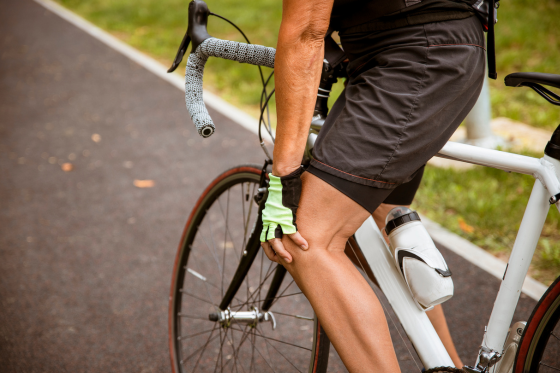
Cycling is frequently recommended to people with knee problems, and for good reason.
It is low impact, the load is controlled, and it allows high volumes of movement without the ground reaction forces of running or the twisting of court sports.
Which is why it gets prescribed constantly in rehabilitation.
And it is also why cycling knee pain is so frustrating when it happens, because the activity you were told was kind to your knees has started to hurt.
Here is the useful part: in cycling, the location of your pain maps reasonably reliably onto specific setup and loading issues.
Why Location Is So Informative
Cycling is a closed, repetitive movement.
Your foot is fixed to a pedal. The range of motion is identical on every revolution. At 80 revolutions per minute for an hour, that is roughly 4,800 near identical cycles through the same range.
Which means small setup errors are repeated thousands of times, and the tissue that ends up complaining is the one that error loads most.
Compare that with running or court sport, where every step is slightly different and the load distributes more variably.
The upside of that repetitiveness is that it makes the problem findable. A consistent error produces a consistent symptom in a consistent location.
Pain at the Front of the Knee
The most common presentation in cyclists.
Where: around or under the kneecap, sometimes just below it at the patellar tendon.
What it usually points to:
Saddle too low. This is the classic. A low saddle increases the amount of knee bend at the top of the pedal stroke, which increases the compressive forces through the kneecap on every revolution.
Saddle too far forward, which has a similar effect by increasing knee flexion and shifting load forward.
Cranks too long for your proportions, which again increases the knee bend at the top.
And gearing. Pushing a big gear at a low cadence increases the force required per revolution, which loads the front of the knee considerably more than spinning a lighter gear faster.
The practical fix for most people: raise the saddle slightly, move it back slightly, and increase cadence.
One caution: change one thing at a time and in small increments. Saddle height adjustments of a few millimetres matter, and changing three things simultaneously means you cannot tell what helped.
Pain at the Back of the Knee
Where: behind the knee, sometimes extending into the upper calf or hamstring attachment.
What it usually points to:
Saddle too high. This is almost the opposite problem. A high saddle means your leg is reaching full extension, or very close to it, at the bottom of each stroke, which places the structures at the back of the knee under repeated tension.
Saddle too far back, which has a similar effect.
And a rocking pelvis. If your hips rock side to side as you pedal, that is usually a sign the saddle is too high, and it adds its own problems further up.
The practical check: at the bottom of the pedal stroke, your knee should retain a slight bend. If your leg locks out, or if you have to point your toes to reach, the saddle is too high.
Pain on the Inside or Outside of the Knee
Where: along the inner or outer joint line, or at the outside just above the joint.
What it usually points to:
Cleat position and foot alignment, which determine how your knee tracks through each revolution. A cleat rotated incorrectly forces the knee to track in a path it does not naturally take, thousands of times.
Cleat float, meaning the amount of rotational freedom the pedal system allows. Too little float on a rider who needs some is a recognized source of irritation.
Stance width, meaning how far apart your feet are, which affects knee tracking.
And hip strength and control, since the muscles controlling your hip determine whether your knee tracks over your foot or drifts inward.
Outer knee pain specifically frequently relates to the iliotibial band region, and the contributors include saddle height, cleat position and hip control.
The Thing Setup Will Not Fix
Being honest, because bike fit gets oversold as an answer to everything.
A considerable proportion of cycling knee pain is a load problem rather than a position problem.
The pattern: symptoms that began within a few weeks of a change. More miles. More hills. A new training plan. The start of a season. A move to a harder gear. Or a return after a layoff.
If your setup was fine for three years and the pain started a month after you doubled your weekly mileage, the setup is probably not the culprit.
Which means the first question is always what changed, before anybody starts moving a saddle.
Load Management for Cyclists
Build volume gradually, and watch single rides rather than only weekly totals. One ride substantially longer or hillier than anything you have done recently is a common trigger.
Increase cadence, reduce gear. Spinning a lighter gear faster reduces the force per revolution, which reduces knee load for the same overall work. This is one of the more effective adjustments for front of knee pain.
Introduce hills gradually, since climbing increases both force per stroke and knee flexion.
And use the next day test. Ride, then check in 24 hours. Back to your usual baseline means the load was appropriate. Clearly worse means reduce by roughly 20 to 30 percent and build back gradually.
Strength Still Matters
Cycling does not build the strength that protects your knee off the bike.
It develops a specific, repetitive, non weight bearing pattern, which is valuable and which does not transfer well to the demands of walking downstairs, getting out of a chair, or absorbing load on one leg.
Which is why cyclists frequently present with knee problems that look like deconditioning, despite training substantial hours.
Two strength sessions a week covering the quadriceps, hips and posterior chain addresses that gap, and it tends to improve the cycling as well.
When a Professional Bike Fit Is Worth It
If your pain is consistent, reproducible and location specific, a proper fit is likely to help.
If you have changed something about your setup or your equipment recently.
If you have significant leg length difference, previous injury or anatomical considerations, where a generic fit will not account for you.
And if you are putting in substantial hours, where small errors accumulate fastest.
What a fit will not do is compensate for a training spike, build strength, or resolve a problem that originated off the bike.
When to Get It Assessed
Seek prompt assessment for:
A knee that locks or will not fully straighten.
A knee that gives way.
Significant swelling.
Pain that persists off the bike, during walking or at night.
Numbness or tingling in the foot, which may relate to cleat position or to something else entirely.
Pain that is worsening ride to ride despite reducing volume.
Seek same day care for a knee that is hot, red and swollen, particularly with fever.
Get the Diagnosis Before the Adjustment
Moving your saddle is quick and free. Moving it in the wrong direction, repeatedly, while the actual problem goes unaddressed, costs a season.
Power Physical Therapy offers a free discovery visit at no cost and no obligation. You will get a thorough assessment of your knee, hip and ankle, an honest explanation of whether your symptoms point toward setup, load or capacity, and a plan that keeps you riding.
