
Squats, Depth and the Knees Over Toes Argument
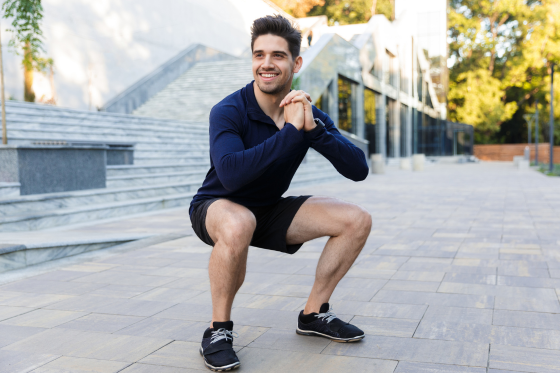
Few pieces of gym advice have been repeated more confidently or examined less than this one.
Do not let your knees go past your toes.
It gets passed from coach to client, parent to child, physio to patient, and it has shaped how a generation of people squat.
It is also a considerable oversimplification, and following it rigidly creates problems of its own.
Here is what is actually going on, along with the more useful question about why your knees hurt in the gym.
Where the Rule Came From
The reasoning is not baseless.
When your knee travels forward over your foot, the forces through the knee joint increase. That is measurable and it is true.
So restricting that forward travel reduces knee joint forces. Also true.
The problem is what happens to the rest of you.
That load does not disappear. It moves. Research examining restricted versus unrestricted squats has found that preventing forward knee travel reduces knee torque while substantially increasing torque at the hip and lower back, because the only way to keep your knees back is to lean your trunk further forward.
Which means the rule does not eliminate load. It relocates it, from a joint built to handle compression to a region that handles it less comfortably.
The Anatomy Problem
There is a second issue, and it is individual.
Whether your knees travel past your toes in a squat depends substantially on things you cannot change.
Ankle dorsiflexion range. The more your shin can travel forward over your foot, the more upright you can stay. Restricted ankles force a choice between forward knees and a forward lean.
Limb proportions. People with long femurs relative to their torso simply cannot squat the same way as people with short ones. The geometry does not permit it.
And hip structure, which varies considerably between individuals and influences stance width and depth.
Which means there is no single correct squat. What looks right for one person is mechanically unavailable to another.
And a practical observation: if you have ever climbed stairs, your knees travelled past your toes. If you have knelt down, squatted to pick something up, or got out of a low chair, the same applies. The position is not exotic.
What About Depth?
The other long standing concern.
Deep squatting is not inherently damaging to healthy knees. Populations around the world squat deeply as a resting position throughout life.
What matters considerably more than depth is load relative to preparation.
Depth you have built up to gradually is generally fine. Depth you dropped into last Tuesday under a loaded barbell is a different proposition.
Two honest caveats:
Depth with a knee problem is a different question. Deep knee flexion under load increases patellofemoral forces, and for somebody with current kneecap pain, limiting depth temporarily is a reasonable modification while capacity is rebuilt.
And depth you cannot control is not depth. If your pelvis tucks under at the bottom, or your heels lift, you have gone past the range you currently own, and that is worth addressing rather than forcing.
So Why Does Your Knee Hurt in the Gym?
Here is the more useful question, because it is rarely technique in the way people assume.
Load progression. Almost every case traces to a change in the preceding few weeks. More sessions, heavier loads, a new program, a return after a layoff, or a jump in volume.
Insufficient recovery between sessions, particularly with high frequency leg training.
Doing too much of one thing. Programs heavy in squatting and leg pressing with little hinging or posterior chain work load the front of the knee disproportionately.
Jumping and landing volume, which is frequently underestimated in conditioning work.
Range of motion limitations, particularly at the ankle and hip, which force compensations.
And strength deficits elsewhere, most commonly at the hip, since the muscles controlling hip position determine whether the knee tracks over the foot or drifts inward under load.
Notice that only one of those is about technique, and even that one is usually a consequence of a restriction rather than a habit.
What Actually Helps
Address the ankle. Limited dorsiflexion is extremely common and it forces either forward lean or heel lift. Test it with a knee to wall test, compare sides, and work on it if restricted.
Address the hip. Hip strength, particularly the muscles controlling rotation, determines knee position under load.
Manage the load. Reduce the provocative movements temporarily rather than stopping, then build back progressively.
Vary the pattern. If back squats hurt, a goblet squat, split squat, leg press or box squat may not. You are not abandoning the movement, you are choosing a version your knee currently tolerates.
Add posterior chain work if your program is squat dominant. Hinging patterns balance the loading.
And use the next day test. Train, then check in 24 hours. Back to your usual baseline means the load was appropriate. Clearly worse means reduce by roughly 20 to 30 percent and build back more gradually.
Practical Adjustments Worth Trying
Shoes with a raised heel, or small plates under the heels, which reduces the ankle range required and lets many people squat more comfortably while they work on mobility.
A slightly wider stance, or a small amount of toe turnout, which suits many people better than a narrow parallel stance.
Tempo. Slowing the lowering phase frequently reduces symptoms and improves control.
And partial range work temporarily, building depth back gradually rather than training around the movement entirely.
The Summary on Knees and Toes
It is not a rule, it is a trade off.
Restricting forward knee travel reduces knee load and increases hip and back load.
Allowing it does the reverse.
Neither is universally correct, and the right answer depends on your anatomy, your ankle mobility, your current symptoms and what you are training for.
Which is precisely what an assessment is for, rather than applying a rule somebody repeated in a gym twenty years ago.
When to Get It Assessed
Seek prompt assessment for:
A knee that locks or will not fully straighten.
A knee that gives way.
Significant swelling, particularly within hours of a session.
Inability to bear weight.
A pop with loss of function.
Sharp pinpoint pain on a bone that worsens with continued activity.
Numbness, tingling or weakness.
Seek same day care for a knee that is hot, red and swollen, especially with fever.
And get assessed if pain persists beyond two weeks despite reducing your load, or if it is worsening session to session.
Train Around It Rather Than Stopping
Most gym knee pain is a loading and capacity issue, which means it usually responds to adjustment rather than to giving up the movements you want to do.
Power Physical Therapy offers a free discovery visit at no cost and no obligation. You will get an assessment of your knee, hip and ankle, an honest explanation of what is driving your symptoms, and a plan that keeps you training while it resolves.
